
Emergency Call-Outs Subject to Availability
Get In Touch
- Service
Signs Your Heating System May Need a Power Flush
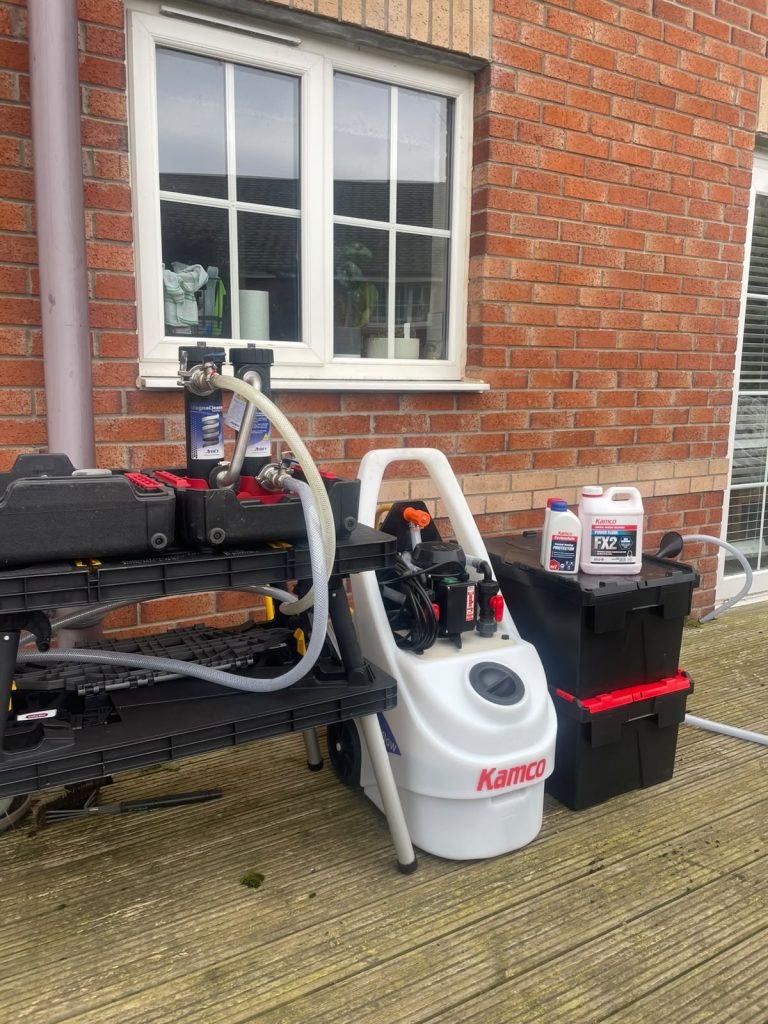
Cold spots on radiators, slow circulation and dirty heating water can be signs that magnetite, rust and sludge have built up inside a central-heating system. Heat Tech Scotland provides professional power flushing across Edinburgh and the surrounding regions using specialist Kamco CF90 equipment. Crucially, we diagnose the system first: not every heating problem needs a power flush.
Is It Time to Replace Your Boiler?
- Radiators are hot at the top but cold across the bottom
- Some radiators heat while others remain cool
- The heating takes a long time to warm the property
- Radiators need repeated bleeding or circulation seems poor
- Boiler or pipework is unusually noisy
- Water drained from the system is very dark or contains visible debris
- A pump, valve or heat exchanger has been affected by contamination
- A new boiler is being installed onto an older, dirty heating circuit
These symptoms can also have other causes, including trapped air, incorrect balancing, valve faults, pump problems or boiler issues. We therefore inspect the system before recommending a power flush.
What Is Power Flushing?
Power flushing uses a high-flow flushing machine and appropriate cleaning chemicals to circulate water through the heating system, loosen corrosion products and remove suspended debris. The goal is to improve circulation and leave the system water in a condition that is more suitable for efficient, reliable operation. It cannot reverse physical corrosion damage, repair blocked pipework in every case or restore components that have already failed.
Our Kamco CF90 Power-Flushing Process
A structured, diagnosis-first process designed to clean the heating system and restore reliable circulation.
Assess the Heating Problem
We check the system symptoms and establish whether contamination is likely to be the cause. If another fault is more likely, we explain that instead of selling a flush that will not solve the problem.
Connect Professional Flushing Equipment
The Kamco CF90 is connected into the heating circuit at an appropriate point so cleaning water can be circulated through the system.
Circulate Cleaning Chemicals
Suitable system-cleaning chemicals are used to loosen magnetite, rust and sludge. Chemicals and procedures are selected for the system and used according to product instructions.
Work Through the Radiators
Radiators are worked through methodically so contamination is removed rather than simply moved around the system. Flow can be reversed to help disturb stubborn deposits.
Flush Until Water Is Satisfactory
Contaminated water is displaced with clean water until the system condition has improved to an acceptable standard.
Add Inhibitor & Recommission
The system is refilled and corrosion inhibitor is added where appropriate. We restore operation, vent and check the heating system and explain any remaining issues.
What Results Should I Expect?
Where sludge is genuinely the cause of poor circulation, a thorough power flush can improve radiator heat distribution, reduce noise and help the system circulate more effectively.
Results depend on the age and physical condition of the pipework and radiators. A flush cannot repair a radiator that is internally corroded through, a failed pump, undersized pipework or a mechanical boiler fault.
Power Flushing Before a New Boiler
When a new boiler is fitted to an existing heating circuit, the system should be appropriately cleaned and protected.
A full power flush is not automatically required on every installation, but it can be appropriate where significant contamination is present. Heat Tech Scotland can assess this during a boiler survey.
Learn about boiler installation →How Much Does Power Flushing Cost?
The price depends on the number of radiators, system layout, condition and time required.
Rather than publishing a figure that may be wrong for the property, provide your number of radiators and postcode so Heat Tech Scotland can give you a useful indication.
Want an indication of power-flushing cost?
Tell us your postcode and number of radiators and we can advise further.
Request a Quote →Frequently Asked Questions
Clear answers to common questions about power flushing, heating system cleaning, and radiator performance.
How long does a power flush take?
Many domestic systems take roughly four to eight hours, but heavily contaminated or larger systems can take longer. The aim is to achieve a proper clean rather than rush to a fixed finish time.
Will a power flush fix cold radiators?
It can if sludge or restricted circulation is the cause. Cold radiators can also be caused by balancing, air, valves, pump faults or other issues, so diagnosis comes first.
Is power flushing safe for old radiators?
Power flushing should be carried out by an experienced professional who assesses the system first. Very corroded components may already be close to failure; flushing can expose pre-existing weaknesses rather than create the corrosion itself.
Do I always need a power flush with a new boiler?
No. The heating system should be cleaned to the standard appropriate for the new boiler, but the required method depends on contamination and system condition.
How often should I power flush my heating system?
It is not an annual maintenance task. A correctly protected system may never need another full power flush. Good inhibitor levels, repairs to causes of oxygen ingress and ongoing maintenance reduce future sludge formation.
What machine do you use?
Heat Tech Scotland’s existing service uses a Kamco CF90 professional power-flushing machine.